Walking the England Coastal Path from Cooden Beach to Hastings is not just a hike; it’s an experience filled with natural beauty, rich history, and cultural exploration. From the tranquil sands of Cooden Beach to the vibrant atmosphere of Hastings, this route offers something for everyone.
1. Cooden Beach to Bexhill-on-Sea
Start your journey at the Relais Cooden Beach Hotel, where you can grab a coffee or a hearty breakfast before setting out.
Cooden Beach is typical of the East Sussex coast line, characterised by a long stretch of shingle divided up by wooden groynes. As the tide retreats, the beach reveals soft flat sands, giving it a very different look. Ideal for a morning walk, you might see locals enjoying fishing or dog-walking.

As you walk along the shingle beach take a moment to take a look at the information boards that describe the importance of the shingle coastline and variety of plants and wildlife that take advantage of this unique habitat.

Shingle can be quite challenging to walk on, so it is important to wear some good comfortable footwear. Follow the beach for a short while until you reach the concrete promenade that runs parallel to the beach. You will pass several nice beach properties on your left, then will some low-level grassy cliffs and several whitewashed beach huts. I am always curious about who makes use of them these days!

Continue along the promenade past a line of multicoloured concrete beach huts, which certainly brighten up the drab concrete approach to Bexhill-on-Sea.

2. Bexhill-on-Sea
Walking along the western edge of the promenade, you notice distinct change of pace and atmosphere as the town has much more vibrant feel about it. Some nice landscaping and coffee retreats provide an additional welcoming atmosphere.

As you move toward the town centre, you’ll pass the Bexhill Clock Tower, built in 1904, it is a brightly decorated Edwardian landmark commemorating King Edward VII.

Approaching the town centre, the promenade broadens around the De La Warr Pavillion, a Grade I listed modernist masterpiece. This iconic building, opened in 1935, is an architectural masterpiece set against the backdrop of the sea.
Inside, you can explore contemporary art exhibitions, enjoy a café, or attend a performance. The pavilion often hosts events and markets, making it a lively spot to visit.
Immediately east of the Pavilion is the Grade II listed King George V Colonnade, which was built in 1911


Bexhill is a hub for water sports, and its rowing club, which was founded in 1893, has a strong history of success, including holding multiple British and world records, and representing Great Britain in international competitions.


The Bexhill War Memorial is a prominent Grade II listed monument situated on the seafront. The memorial was designed by the prolific sculptor Louis Frederick Roslyn, is made of Portland stone and features in a striking bronze sculpture of ‘Victory’.

Bexhill’s Victorian development is characterised by substantial houses and terraces built in brick with Bath stone, giving the town a distinctive ‘red’ look. Dutch gables, domes and turrets are common features, contributing to the ‘Orientalist style‘ that flourished along the seafront at the time.
The East Parade was originally the more fashionable area and was part of the Earl De La Warr’s private estate until 1913. It featured long runs of elegant Victorian style buildings, occasionally interspersed with later, post-WWII structures.

As you walk along the promenade keep an eye out for the stone plaque commemorating Britain’s first international motor race, held here in 1902.

As you walk along the promenade you will note a number of information boards about the towns heritage links to motor racing.
Bexhill-on-Sea is officially recognised by the RAC as the birthplace of British motor racing. This stems from the historic events of 19 May 1902, when the town hosted the first international motor race meeting in Great Britain,
The event was the brainchild of the 8th Earl De La Warr, who sought to elevate Bexhill’s status to rival glamorous resorts like Monte Carlo. He used his private ‘cycle boulevard’ along the seafront, which was exempt from the national speed limit of 12mph, to create 1 kilometre dirt track from Galley Hill to Sackbille Lawns.
Over 200 entries from across Europe competed, drawing a crowd of over 30,000 spectators. The main speed trials were won by French driver Leon Serpollet in his steam-powered car, nicknamed the ‘Easter Egg’ due to its distinctive shape. He reached a top speed of 54mph along the promenade.


There is a real mixture of quite ugly seafront buildings as you continue your journey along the promenade, a real missed opportunity to create something quite beautiful. But the shingle beach remains a constant in an ever changing architectural reinvention that goes on to keep the town relevant and attractive to newer generations.

Towards the end of East Parade you will come across a large row of white painted beach huts which add a sense of nostalgia against the drab seafront buildings behind.

2. Gally Hill to Bulverhythe
Leaving Bexhill you there is climb to Galley Hill, which serves as a dramatic natural vantage point at the end of Bexhill’s promenade. It is the highest point between Eastbourne and Hastings, offering panoramic views of the English Channel and the rout towards Hastings Pier.
Follow the path down the hill, past more white painted beach huts.along Glyne Gap Beach and the railway on the left.


As you approach St Leonard’s you pass the Southern Rail’s St Leonard’s West Marines Depot (rail depot) on your left and Bulverhythe Beach on your left.

Bulverhythe Beach is one of the most remarkable archaeological sites in the UK. This stretch of shoreline is home to the wreck of the ‘Amsterdam’ a Dutch East Indiaman that ran aground here on 26 January 1749.
Already suffering from an outbreak of plague, the captain was forced to beach the vessel at high tide to save the remaining crew.
The ship quickly sank into the soft, anaerobic clay of the beach, which acted as preservative for its wooden hull and 28th century cargo. It remains the most completely preserved VOC (Dutch East India Company) ship in the world


The coastal path shares the route with the National Cycle Network Route 2. As you enter St Leonard’s-on-Sea follow the path between the numerous beach sheds and past the TS Hastings Sea Cadets & Royal Marne Cadets building on your left on to Cinque Ports Way.
The TS Hastings Sea Cadets is a maritime youth charity that provides adventure- based training for young people aged 10 to 18.

At the end of Cinque Ports way you will find yourself looking at the Bulverhythe Beach Huts, rows of vibrant multi coloured beach huts, with the town of St-Leonards-on-Sea providing a fabulous, presenting a great photo opportunity.


3. St Leonards-on Sea to Hastings
As you pass the beach huts look to you right and you will be passing the site of the Old Bathing Pool site. Once a massive 1930’s lido, it is now an open green space and a canvas for local street art. One of the many interesting steel sculptures along the path are the ones depicting Jimi Riddle and Ann Novotny.


Near the Marina area, keep an eye out for ‘Marina’ a dramatic stainless steel sculpture by local artist Leigh Dyer. Unveiled in 2023, the piece is inspired by mussel shells and maritime themes, reflecting the town’s nautical heritage.


Dominating the skyline is Marine Court, an iconic Grade II listed Art Deco apartment block. Completed in 1938, its design was famously modelled after the hull of the ocean liner Queen Mary. It stands as a towering example of the ‘New Brighton’ vision for the town.


As you walk along the promenade you will pass St Leonard’s Parish Church, which has been closed since 2018 due to structural problems. The church is a Grade II listed building known for its unique modern gothic architecture and nautical themed interior.
A bit further long you, past Marina Court, you will see the distinctive tower of Christ Church, another Grade II listed building renowned for its grand early gothic revival architecture.


Continuing east, you reach Warrior Square, the centrepiece of St Leonard’s-on-Sea. Developed between the 1850s and 1870s, Warrior Square was designed to be the most prestigious address in the borough, often referred to in 19th century guide books as the ‘Belgravia’ of Hastings. The square is flanked by towering, elegant terraces that exemplify the high Victorian style.
The central Warrior Square Gardens cover approximately 17,300 square meters and are divided into three distinct sections that slope toward the English Channel.
The Rose Garden, located at the northern end (upper) offers a quiet retreat with well maintained rose beds and elevated views over the rest of the square and the sea. The Middle Section is an expanse of lawn often used for community events, food festivals and art installations.
The Lower Garden, facing the seafront, features seasonal flowers and serves as the setting for the squares most famous monument.
At the seaward entrance stands the bronze Queen Victoria Statue, unveiled on 31 December 1902. It was designed by F J Williamson, Queen Victoria’s private sculptor and depicts her in the exact gown and jewels she wore for her 1887 Golden Jubilee.
If you look closely at the statue’s skirt/knee area you will find a genuine bullet hole caused by a Luftwaffe pilot in a Messerschmitt Bf 109 during a ‘tip and run’ raid in World War II.


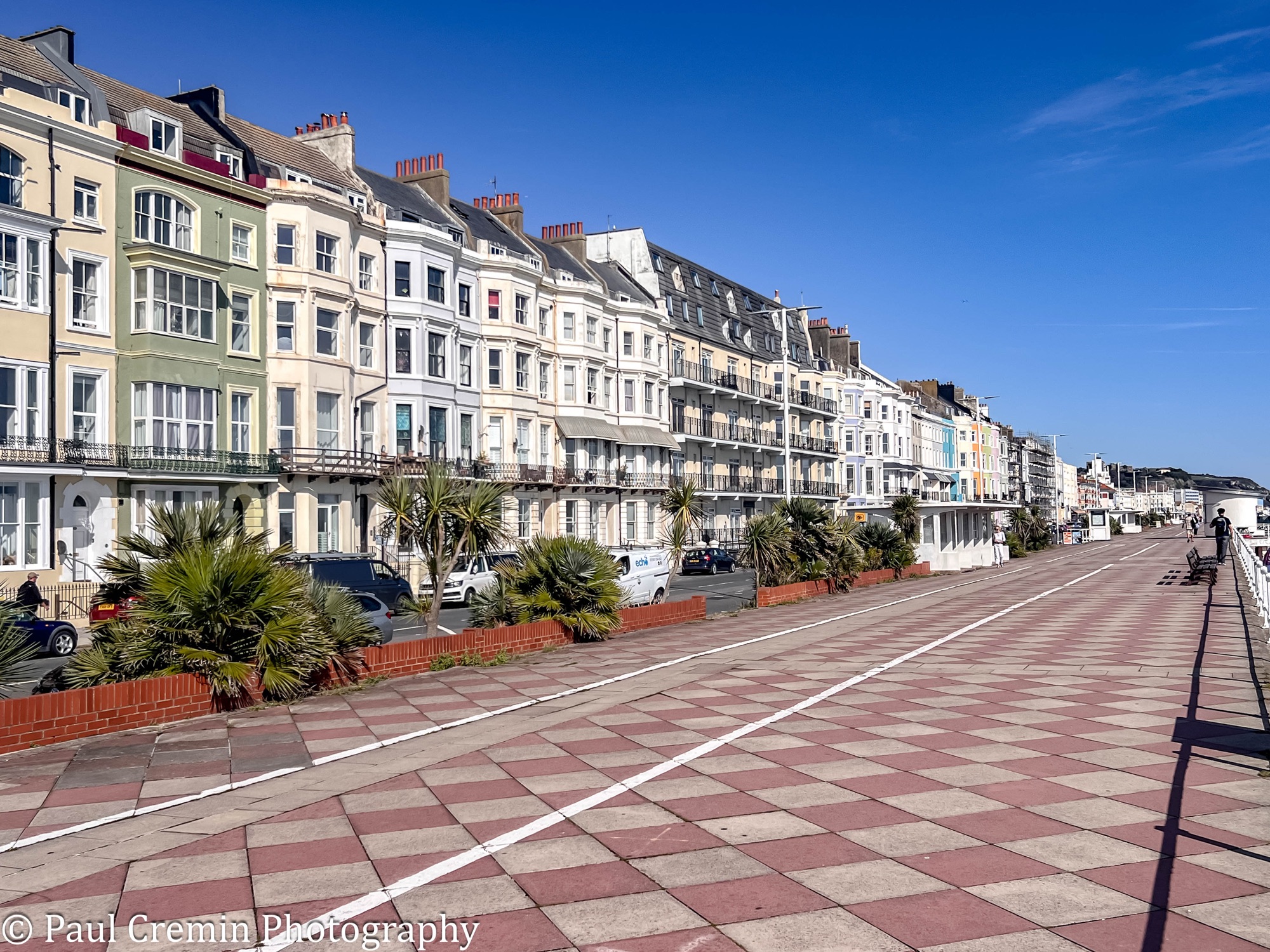
Nestled in the heart of T Leonards-on-Sea, the promenade at Eversfield Place remains one of the most evocative stretches of the Sussex coastline. This elegant thoroughfare offers a perfect blend of historic grandeur and modern seaside charm.
The promenade is dominated by the imposing terrace of Eversfield Place, construction starting in 1851. As you walk along the upper level, you are flanked by ‘handsome’ period residences that once served as fashionable lodging houses for the 19th century elite. Today these buildings remain a centre piece of the Warrior Square Conservation Area, mainly renovated into boutique apartments with expansive bay windows that frame uninterrupted views of the English Channel.
Note the weather kiosk, which was built in 1935, as part of Sidney Little’s seafront modernisation plan, replacing an earlier wood structure. The formal collection of weather data in Hastings and St Leonards started in 1875, making it one of the oldest stations in the country. The daily observations are still carried out by a team of dedicated volunteers, known as the Hastings Voluntary Weather Observers.


This leg of my journey ends at the Hastings Pier, a historic Victorian pleasure pier, which originally opened in 1872. Known for its resilient history and award-winning modern architecture, it is sadly not looking its best and is currently the focal point for local community efforts to return it to public ownership. But the Pavilion Restaurant and Bar is a striking modern piece of architecture and you should definitely take advantage of a tea or coffee to take the edge of those breezy conditions.

The pier remains a great place to take a stroll and take in some fantastic views of the St Leonards and Hastings coastline.

Not far from the pier you will come across the Boer War Memorial, which honours the 50 local men that died in that conflict. The Grade II listed Memorial is made of Peterhead granite and stands roughly 22ft high.


The ‘Norman Longboat’ sculpture is an iconic piece of public art titled ‘The Landing’ located on the shingle beach at Hastings. It was commissioned in 2016 to mark the 950th anniversary of the Battle of Hastings. There s a time capsule buried beneath the sculpture containing letters from residents to future generations, which will be opened in 2066. The artist, Leigh Dyer, created the piece with the help of the British Artists Blacksmiths Association.

On the way to Hastings station take a moment to observe the lion and unicorn statues located at either end of Robertson Terrace in Hastings, overlooking the seafront. These statues were created by sculptor James George Bibb between 1845 and 1850 for the remodelling of Buckingham Palace. However, they were deemed surplus to requirements and were never installed in the palace. The developer Patrick Robinson acquired the statues and they were brought to Hastings in 1852 by renowned architect Decimus Burton.


As you head into town look up to the right where you will see West Hill and what remains of the outer perimeter wall of Hastings, the subject of a separate post (Part 3a). Hastings Castle holds a unique place in British history as the first Norman motte-and-Bailey castle built in England by William the Conqueror.

As you walk past the town hall, you see a statue of Prince Albert. Made of Portland Stone the sculpture has has a tumultuous history, including being part of a clock tower that was demolished and spending decades in a greenhouse. Following a community campaign the statue was finally reinstalled in a public place. It was erected on a new Portland stone pedestal outside the Hastings Town Hall.
The statue, which depicts Prince Albert in the robes of the Order of the Garter, is weathered from its years exposed to the elements and neglect.


Tips for the Journey
- Footwear: Opt for sturdy, comfortable walking shoes as the terrain can vary. Trails can be uneven, especially near the cliffs.
- Weather: Check local weather conditions before heading out. Coastal weather can change rapidly, so layers are advisable.
- Time: Plan for about 4-6 hours for the entire walk, including time for breaks, exploration, and photography. Starting early in the day allows you to enjoy the landscape in different light.
- Refreshments: Bring water and snacks, but also consider stopping at local cafés for a break. Bexhill and Hastings offer plenty of options.
Leave a Reply